Valentin Guigon’s March Madness 2026 Forecast
Probabilistic forecasting, bracket construction, and portfolio strategy for the 2026 NCAA Men’s and Women’s Basketball Tournaments.
Submitted Anchor Entries
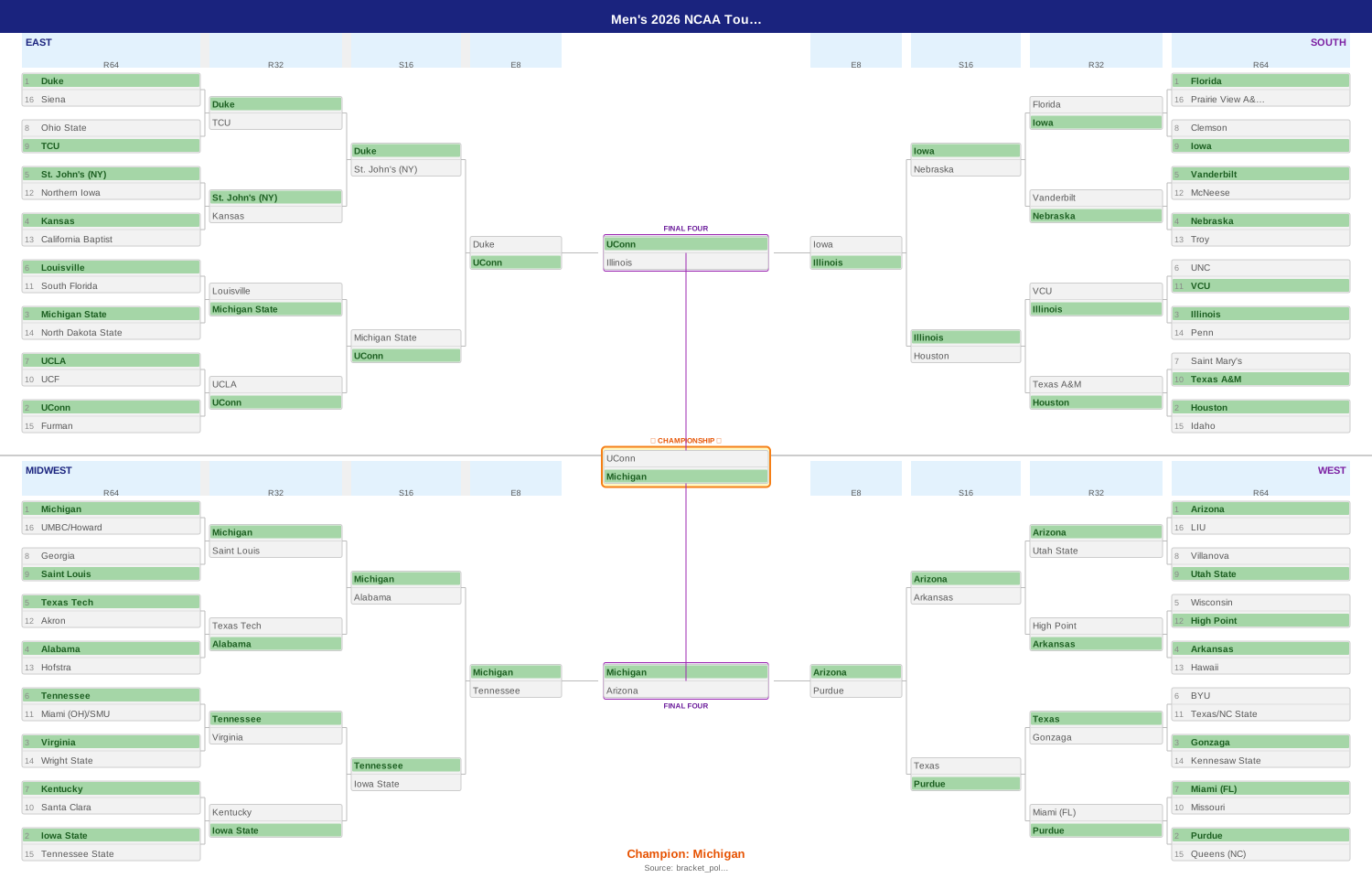
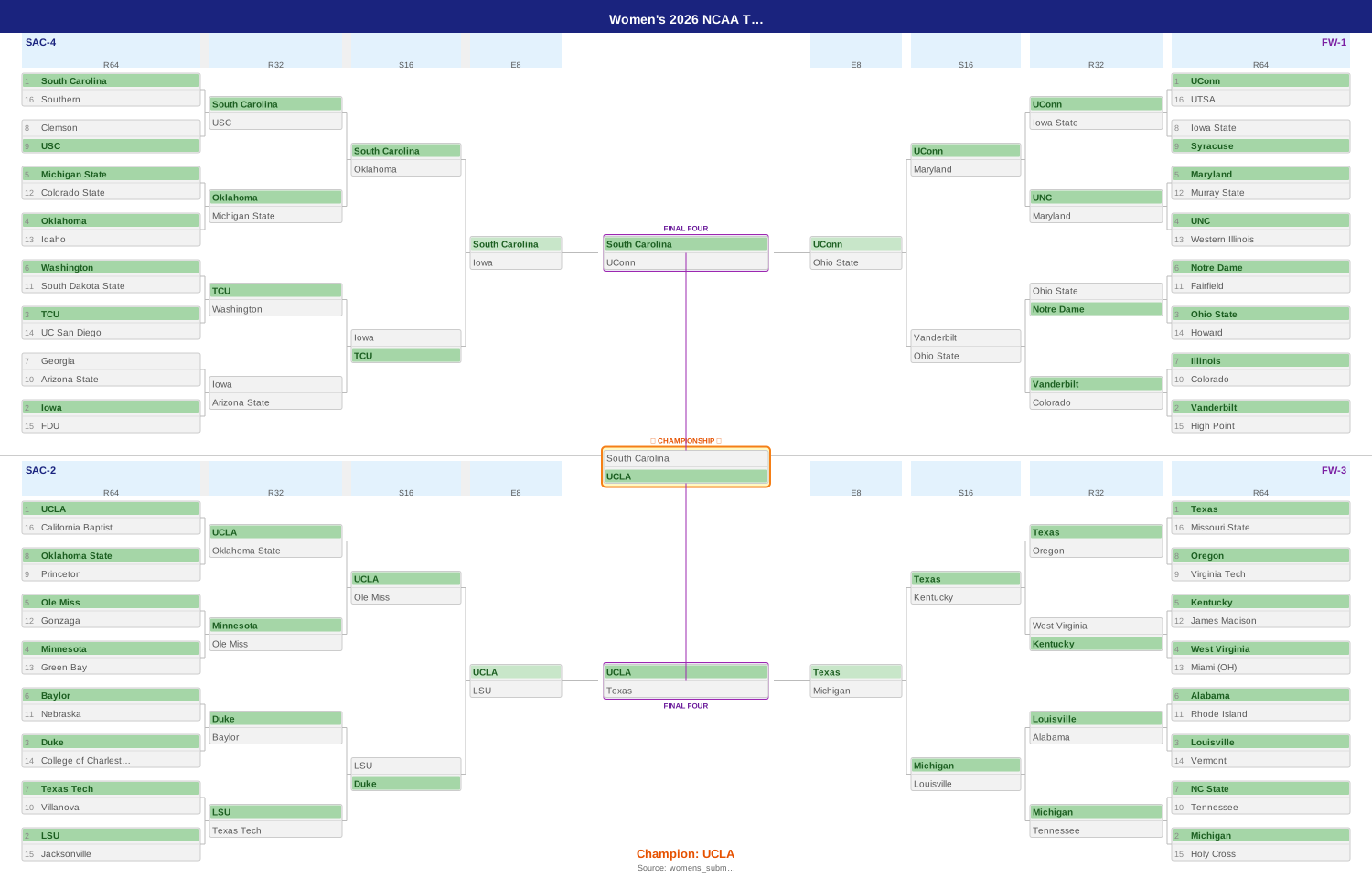
The two anchor brackets submitted before the tournament began. Expected scores are ex ante (pre-tournament, based on simulation under Scenario 1). Final scores below are the latest conditional_total_ev values from the canonical championship live-state artifacts. At the championship-complete state, remaining EV is zero and conditional_total_ev equals realized cumulative score.
| Entry ID | E01 |
|---|---|
| Model | FM-01 |
| Bracket policy | BP-01 |
| Champion | Duke |
| Final Four | Duke · Michigan · Florida · Arizona |
| Ex ante expected score | 1183.3 pts (SCN-01) |
| Current state | Championship complete (2026-04-06) |
| Current rank | 8 of 10 |
| Correct predictions by round | R64 25/32; R32 10/16; S16 5/8; E8 2/4; F4 1/2; Championship 0/1 |
| Current cumulative score | 970 pts |
| Current expected final score | 970.0 pts |
| Entry ID | W-E01 |
|---|---|
| Model | W-LEG-FM-01 |
| Bracket policy | W-BP-01 |
| Champion | UConn |
| Final Four | UConn · Texas · UCLA · South Carolina |
| Ex ante expected score | 1177.7 pts (SCN-01) |
| Current state | Championship complete (2026-04-05) |
| Current rank | 4 of 10 |
| Correct predictions by round | R64 28/32; R32 12/16; S16 5/8; E8 4/4; F4 1/2; Championship 0/1 |
| Current cumulative score | 1200 pts |
| Current expected final score | 1200.0 pts |
What’s here
| Forecast | Men’s and Women’s tournament forecasts, brackets, and portfolio analysis |
| Portfolio | Whole-portfolio architecture, concentration/diversification read, and linked track detail surfaces |
| Data | Data overview, feature summary, and historical tournament coverage |
| Updates | Tournament-day result integration and forecast revisions |
| Method | Forecasting approach, model family, and calibration |
| Technical reports | Model, forecast, and deep-dive report pages by track |
Forecasting approach
Both tracks use logistic regression model families trained on historical NCAA tournament matchup data. Predictions are probability-calibrated, simulated across 10,000 bracket paths, and organized into a portfolio of bracket entries optimized for expected score.
See Method for details.
Last updated: 2026-04-09